Courses
29 results for:
AI Agents Full Course 2026: Master Agentic AI (2 Hours)
Beginner🔥 Join Maker School & get customer #1 guaranteed: https://skool.com/makerschool/about 💎 Check out my SaaS, Clairvo (we 2x your pickup rate): https://clairvo.io?s=nick ➡️ Get all AI agent course resources 100% free: https://skool.com/maker-zero/about If this is your first video: I'm Nick Saraev. I run LeftClick, an AI growth agency. We've done work for large brands you're likely familiar with, like Mr. Beast, Anthropic, OpenAI, and a few others. In plain English: I help people build systems that generate leads, close deals, and scale businesses, mostly using new AI models like Claude. I also make videos about how to do all of that here on YouTube. It hasn't always been this way. My family immigrated from a Soviet bloc country (People's Republic of Bulgaria) in the 90s. They worked extremely hard, and we were broke for a very long time. I grew up wishing for more security, stability, and freedom over my own life. I don't have a programming degree, and never took formal education for IT or workflows. I learned it all myself from YouTube videos like you're watching now. As for my path: I started my first business at 19 in college. We threw events (mostly parties) at campus bars, and charged people for entry. That failed to provide me enough money to pay my bills, so at 21, I started another business, a door-to-door marketing agency. From there, every year, I would start several companies, over 10 in total. I did this in a variety of industries, like e-commerce, photography, videography, SaaS, credit repair, etc. Each grew slightly more profitable, until, at 25, I would start 1SecondCopy, a content writing company. A friend and I eventually scaled that to over $90,000/m. It was my first taste of financial independence, and the reason I'm here today. Since starting my journey, I've grown a fair bit of capital. To diversify my income, at 30, I began investing in other businesses and advising companies on how to grow in the AI era. These include SaaS businesses, like Clairvo, agencies like Dental Connect, and more. Collectively, the businesses that I own outright or are a part of generate over $10 million per year. This returns far more than the 5-10% you would get in the stock market, but also requires a lot of my active time. There's a tradeoff there, but I greatly prefer active investing, where I have control over the entities I'm a part of. It wasn't easy to get here. But I did in the end! For anyone on their own entrepreneurial journey: I wish you luck, happiness, and perseverance. You can make it! Summary ⤵️ Hey, this is an end to end, extremely comprehensive course all about AI agents. It covers the three modern agentic AI tools: Codex, Claude Code, and Antigravity, and is agnostic to whichever you use. I will guide you through initial setup; workspace configuration; and then a variety of foundational to prompting techniques like self modifying agent instructions, multi agent MCP orchestration, video-to-action pipelines, agent chatrooms, subagent verification loops, prompt contracts, reverse prompting, and even more! By the end, you will have learned, no fluff, both foundational AI agent design and advanced prompt engineering both. You will also have mastered a bunch of key agentic AI principles, like context management and token usage optimization! Thanks and happy watching! My software, tools, & deals (some give me kickbacks—thank you!) 🚀 Instantly: https://link.nicksaraev.com/instantly-short 📧 Anymailfinder: https://link.nicksaraev.com/amf-short 🤖 Apify: https://console.apify.com/sign-up (30% off with code 30NICKSARAEV) 🧑🏽💻 n8n: https://n8n.partnerlinks.io/h372ujv8cw80 📈 Rize: https://link.nicksaraev.com/rize-short (25% off with promo code NICK) Chapters 00:00 Introduction to AI Agent Full Course 02:14 Multi-Agent Chrome MCP Workflow Demonstration 04:28 Core Agent Workflow 09:09 Understanding AI Agent Architecture 13:18 The Three Major AI Agent Platforms (Codex, Claude Code, Antigravity) 22:29 Platform-Specific Performance Insights 25:43 Self-Modifying System Prompts 34:57 Standardizing Workflows with Agent Skills 39:03 Multi-Agent Orchestration Strategies 47:20 Video-to-Action Pipeline 56:07 Implementing Stochastic Multi-Agent Consensus 1:04:44 Agent Suggestions Unveiled 1:05:08 Consensus Reports and Insights 1:06:05 Harnessing Multiple Agents 1:07:41 Agent Chat Rooms Explained 1:10:34 Debate and Collaboration Among Agents 1:13:25 Sub-Agent Verification Loops 1:17:32 The Mixture of Experts 1:20:56 Prompt Contracts Introduced 1:24:23 Crafting Effective Prompt Contracts 1:27:40 Reverse Prompting for Clarity 1:31:41 Context Management Strategies 1:37:34 Multi-Agent Chrome Automation 1:48:49 Understanding MCP Tools and Skills 1:53:34 Context Compression Techniques 1:59:19 Optimizing Token Usage 2:06:46 Cost-Efficient Multi-Agent Strategies 2:11:30 LLM Pricing Principles

AI Complete OneShot Course for Beginners | Learn AI & ML Fundamentals from Scratch
Beginner📌New | Complete AI/ML Job Ready Batch :https://www.apnacollege.in/course/prime-ai Batch starting from 15th Nov 2025 -------------------------------------------------------------------------- Link for International students : https://rzp.io/rzp/prime-ai Eligibility for Prime (AI/ML batch) : - B.Tech students preparing for Tech Placement/Internships. - working professionals switching to AI roles - M.Tech/MCA/BCA who are preparing for Tech Placements/Internships Class Schedule : - Mentioned in video & on website. - Lectures will come on weekends - Lecture duration : upto 2.5 - 3 Hours - Some weekends will have additional mentorship sessions. - It will take us 4+ months for completion - Additional projects will be provided in 5th month for more practice. Share your progress on Twitter : https://x.com/ShradhaKhapra_ DSA Series full playlist : https://www.youtube.com/playlist?list=PLfqMhTWNBTe137I_EPQd34TsgV6IO55pt Shradha Khapra Ma'am community Instagram : https://www.instagram.com/shradhakhapra LinkedIn : https://www.linkedin.com/in/shradha-khapra/


Artificial Intelligence Full Course (Free) | Master AI Tools & Core Concepts
BeginnerDownload Free Notes Here:- https://www.theiscale.com/DataAnalytics/a-i-full-course-free-master-ai-tools-core-concepts-notes 🚀 The wait is over! Welcome to the Complete Artificial Intelligence Course (Free) — your step-by-step guide to learning AI from scratch. In this beginner-friendly course, you’ll explore how Artificial Intelligence works, understand key AI concepts, and learn to use the latest AI tools like ChatGPT, Gemini, DeepSeek, NotebookLM, and AI Agents to build real-world projects. 📘 What You’ll Learn: . What is Artificial Intelligence & how it works . Machine Learning vs Deep Learning . AI Tools for productivity, content creation & coding . AI Agents & Automation basics . Real-world AI applications & projects . Future of AI and career opportunities Time Stamp 00:00 - Introduction 03:30 - AI Operators & AI Builders 07:00 - AI tools 07:02 - Note book LM 07:55 - Generating interview questions with AI 14:21 - Generating Social Media content 17:16 - Converting text data to video data 18:48 - Google Gemini 20:20 - Converting reports to insights 23:25 - Data Visualization through AI 27:48 - Using chat gpt as data analyst 30:54 - Data processing with AI 33:45 - Transforming data to graph 37:27 - Prompt writing technique for better output 41:50 - Manus AI 42:00 - Difference between Chat gpt and Manus AI 48:12 - Making Website through AI Agent 55:17 - Deepseek AI 58:39 - Deep Seek advantage over chat gpt 58:26 - Model training behind deepseek 01:11:02 - Deepseek for writing codes 01:11:42 - Introduction to Generative & Agentic AI 01:13:48 - Generative AI growth in tech 01:15:20 - Prompt engineering in Gen AI 01:20:48 - Limitations of Gen AI 01:21:02 - Agentic AI 01:24:00 - Automation and Autonomous Workflows 01:25:22 - Agentic AI Systems 01:27:42 - chat gpt vs world's first AI agent Manus 01:32:30 - LLM, AI Workflows & AI Agents 01:36:24 - LLM Model Training 01:37:44 - Introduction to AI Workflow 01:42:08 - Architecture of AI Agents 01:58:41 - Working of AI workflows 02:00:14 - Types of AI Agent 02:01:08 - Single AI Agent 02:04:35 - Multi AI Agent 02:06:10 - Sequential Pattern 02:08:40 - Hierarchical Pattern 02:11:35 - Hybrid Pattern 02:12:32 - Parallel Pattern 02:13:19 - Asynchronous Pattern 02:14:25 - Types of AI Agents 02:15:27 - Simple Reflex AI Agent 02:16:36 - Model Based Reflex AI Agent 02:17:24 - Goal Based AI Agent 02:19:19 - Utility Based AI Agent 02:22:13 - Learning Based AI Agent 02:26:05 - Coding Assistant Agent: 02:27:15 - E-commerce and Product Research AI 02:28:49 - Healthcare Assistant 02:30:21 - Agentic applications 02:31:00 - Final Project for Building AI Agent for free 02:51:56 - Conclusion of AI course 🧠 Who This Course is For: . Complete beginners who want to start with AI . Students & professionals exploring new career paths . Content creators, coders & entrepreneurs 🎯 Whether you want to build your first AI project or understand how AI tools can boost your career — this free course is your ultimate starting point! ✨ Kickstart your career in a Data Analyst. Apply today! - https://www.theiscale.com/DataAnalytics/data-analyst-course-form ❇️ Explore our Job Oriented Courses: https://www.theiscale.com/explore-course ➖➖➖➖➖➖ 📱 For Any Further Query or Doubts? Contact- 7880-113-112 (Student Helpline Number) For any query connect in WhatsApp with us: https://wa.me/917880113112 ➖➖➖➖➖➖ ✳️ Join Telegram Channel- https://t.me/TheiScale ✳️ Join WhatsApp Channel- https://whatsapp.com/channel/0029VaB5ekEKQuJQV572vi2c ➖➖➖➖➖➖➖ 🔗 Download App Google Play : https://play.google.com/store/apps/details?id=com.logixhunt.ihhpet&pli=1


Learn Full Excel Course from Basic to Advanced with AI | Excel AI Masterclass 2026
BeginnerLearn Full Excel Course from Basic to Advanced with AI | Excel AI Masterclass 2026 #SD108 If you want to become confident in Microsoft Excel and learn practical Excel skills used in real jobs, this masterclass is for you. In this complete course, you will learn Excel step by step from beginner level to advanced level with practical examples and AI-powered productivity techniques. This Excel Masterclass is specially designed for: ✔️ Students ✔️ Office Employees ✔️ MIS Executives ✔️ Data Analysts ✔️ Freelancers ✔️ Business Owners ✔️ Job Seekers Important Links 👉All Practice Files : https://edu.skillcourse.in/free-video/8 🔴Freelancing Mastery Program : https://edu.skillcourse.in 👉Excel Beginners to Advance Masterclass Exam & Certificate Link (Instructions Given in the Video) : https://edu.skillcourse.in/dashboard/tests/30 🚀Excel AI Automation Masterclass Video : https://youtu.be/Zykv4eaVzcQ?si=m_hai456XzR5GVbU Lesson 1-Excel Introduction - 05:58 Lesson 2-Data Entry in Excel - 43:41 Lesson 3-Essential Formulas - 01:13:10 Lesson 4-IF Formulas in Excel - 01:30:35 Lesson 5-Nested IF and IFS Formula - 01:51:25 Lesson 6-Conditional Formatting - 02:13:29 Lesson 7-Sort Data in Excel - 02:38:40 Lesson 8-Filter Data in Excel - 02:52:42 Lesson 9-Sort and Filter Formula in Excel - 03:14:26 Lesson 10-Data Validation - 03:36:12 Lesson 11-Remove Duplicate,Text to Columns, Flash Fill - 03:49:44 Lesson 12-Paste special & GoTo Special - 04:03:57 Lesson 13-31 Excel Formulas - 04:41:38 Lesson 14-Pivot Table Masterclass - 06:20:46 Lesson 15-PowerPivot Table - 09:46:44 Lesson 16-Office 365 and Latest formulas - 11:46:38 Lesson 17-AI Use in excel - 12:58:26 Lesson 18-Claude AI Extension in Excel - 14:07:39 Lesson 19-Freelancing - 14:40:01 🎯 This course will help you: ✔️ Improve productivity ✔️ Work faster in Excel ✔️ Build professional reports ✔️ Handle large datasets ✔️ Learn automation techniques ✔️ Prepare for office jobs and interviews ✔️ Improve Data Analysis skills Whether you are learning Excel for jobs, freelancing, office work, reporting, dashboards, or data analysis, this complete Excel course will help you master Excel professionally. 🔔 Subscribe for more Excel, Power BI, SQL, Python & AI tutorials Trainer: Satish Dhawale #Excel #ExcelCourse #AdvancedExcel #MicrosoftExcel #ExcelTutorial #ExcelMasterclass #AIinExcel #DataAnalysis #PivotTable #ExcelFormulas Get Free Notification for Upcoming Videos = https://forms.gle/5Jz1WJSki3nJrb6v7 ------------------------------------------------------------------------------------------------------------------------------ Learn Satish Sir courses with Certificate Course Website :https://skillcourse.in/ ------------------------------------------------------------------------------------------------------------------------------ Follow us on LinkedIn : https://www.linkedin.com/in/satish-dhawale/ ------------------------------------------------------------------------------------------------------------------------------ Check our latest blogs: https://learnmoreindia.in/ ------------------------------------------------------------------------------------------------------------------------------ Social media Pages: Skill Course LinkedIn : linkedin.com/company/skill-course/ Facebook Page Link: https://www.facebook.com/learnmoreeasily/ Instagram Page Link: https://www.instagram.com/_learn_more_pro_/ Telegram channel: https://telegram.me/learnmoreindia Follow us on X : https://x.com/Satish_Dhawale_ ------------------------------------------------------------------------------------------------------------------------------ My Other Channels: Satish Dhawale: ✅ https://www.youtube.com/@Satish_Dhawale Real Tutorial: ✅ https://www.youtube.com/@realtutorial550 Complete Technology:✅ https://www.youtube.com/@CompleteTechnology Learn more shorts:✅ https://www.youtube.com/@LearnMoreShorts Satish Tech (Marathi):✅ https://www.youtube.com/@Satish_Tech Tally Tutorial:✅ https://www.youtube.com/@TallyTutorial I Love Excel by Skill Course:✅ https://www.youtube.com/@Excel_Tutorial Learn More:✅ https://www.youtube.com/@Learn_More_Pro Curiosity: ✅ https://www.youtube.com/@curiosity9432 ------------------------------------------------------------------------------------------------------------------------------ My YouTube Gears : Best Mic for Recording (Condensor Mic): https://amzn.to/2UUMDnH Best Mic for Recording (Dynamic Mic ): https://amzn.to/3pQgyvD My DSLR Camera Canon 200D: https://amzn.to/39ciw3E My Laptop (Video Editing): https://amzn.to/2UXQj8h Laptop (Office Use/ Home use / Budget Laptop) : https://amzn.to/3l0pniw Antivirus: https://amzn.to/3l3TIgi Screen Recording Software: https://bit.ly/2J39n2j Video Editing Software: https://bit.ly/3nOPlri Green screen with Stand: https://amzn.to/2KAl1Cu


Complete RAG Crash Course With Langchain In 2 Hours
Intermediategithub: https://github.com/krishnaik06/RAG-Tutorials Retrieval-Augmented Generation (RAG) is the process of optimizing the output of a large language model, so it references an authoritative knowledge base outside of its training data sources before generating a response. Large Language Models (LLMs) are trained on vast volumes of data and use billions of parameters to generate original output for tasks like answering questions, translating languages, and completing sentences. RAG extends the already powerful capabilities of LLMs to specific domains or an organization's internal knowledge base, all without the need to retrain the model. It is a cost-effective approach to improving LLM output so it remains relevant, accurate, and useful in various contexts.

Python for AI - Full Beginner Course
BeginnerLearn Python from scratch and start building real AI applications. This is the fastest, beginner-friendly course Python for AI development. 📕 Course Handbook: https://go.datalumina.com/cm5P6b6 📥 Course Resources: https://go.datalumina.com/M2YfRW3 👊🏻 Let's connect on IG: https://www.instagram.com/daveebbelaar/ 🎙️ Try Glaido, the #1 dictation tool for developers: https://get.glaido.com/dave ⏱️ Timestamps 00:00:00 Introduction: Learn Python for AI 00:01:42 Course Overview & Structure 00:03:58 Installing Python 00:04:05 Installing Python on Windows 00:05:10 Installing Python on Mac 00:06:53 Installing VS Code 00:08:34 Setting Up VS Code (Extensions) 00:12:08 Customizing VS Code 00:13:31 Creating Your First Project 00:16:18 Creating a VS Code Workspace 00:18:02 Your First Python File (hello.py) 00:20:10 Running Python Code 00:26:23 Exercise & Recap 00:29:26 Course Resources & Community 00:31:07 Understanding Python Environments 00:33:15 Understanding Python Packages & Pip 00:34:00 Creating Virtual Environments (venv) 00:37:34 A Note on Anaconda 00:38:32 Installing Python Packages (pip install) 00:42:51 Using Python Packages (Import) 00:44:29 Interactive Python with Jupyter 00:48:30 Full Setup Recap & Exercise 00:51:36 What is Programming? 00:55:19 Understanding Python Syntax & PEP8 00:58:00 Understanding & Debugging Errors 01:01:33 Variables 01:06:03 Comments 01:09:48 Data Types Introduction 01:10:12 Numbers (Integers & Floats) 01:13:36 Strings 01:19:39 String Formatting (F strings) 01:21:49 String Methods 01:26:35 Booleans 01:31:02 Operators (Arithmetic, Comparison, Logical) 01:39:19 Shortcut Assignments (+=) 01:40:24 Control Flow Introduction 01:41:35 Conditional Statements (if, elif, else) 01:47:11 Loops (For Loops & range()) 01:52:13 Data Structures Introduction 01:53:32 Lists 01:59:10 Dictionaries 02:00:23 Tuples 02:01:37 Sets 02:05:51 Functions (Defining & Calling) 02:15:02 Function Parameters & Arguments 02:22:42 Global vs Local Variable Scope 02:28:50 Returning Values from Functions 02:37:37 External Tools (Modules, Packages) 02:40:48 Importing Modules & Built ins 02:47:56 Import Methods Summary 02:48:48 Installing Packages & requirements.txt 02:56:04 Working with APIs (Requests Example) 03:06:20 Working with Data Example (Pandas & Matplotlib) 03:10:46 Reading & Saving Data Files 03:14:50 Practical Python Introduction 03:16:47 Project Structure & Organization 03:22:02 Understanding File Paths 03:26:37 Working with Different File Types 03:34:05 Organizing Code into Modules 03:39:39 Error Handling (Try/Except) 03:45:31 Introduction to Classes (OOP) 03:49:09 Creating Your First Class (__init__, self) 03:57:04 Class Attributes vs Instances 04:00:10 Class Methods 04:05:23 Class Inheritance 04:07:32 When to Use Classes vs Functions 04:09:44 Introduction to Git & GitHub 04:12:31 Git Fundamentals 04:15:41 Installing Git 04:16:46 Basic Git Workflow 04:18:41 GitHub Account Setup & Authentication 04:22:37 Cloning GitHub Repositories 04:28:12 Creating Repositories & .gitignore 04:36:12 Using Git with VS Code UI 04:44:05 Environment Variables & Secrets (.env) 04:52:13 Using python dotenv Package 04:55:03 Introduction to Ruff (Linter & Formatter) 04:56:13 Setting Up Ruff in VS Code 04:57:23 Ruff in Action 05:01:10 Introduction to Uv (Modern Package Manager) 05:02:07 Installing Uv 05:02:30 Using Uv (uv init, add, sync) 05:09:01 Complete Python Project Workflow Exercise 05:11:13 Course Wrap up & What's Next 👋🏻 About Me Hi! I'm Dave, AI Engineer and founder of Datalumina®. On this channel, I share practical tutorials that teach developers how to build production-ready AI systems that actually work in the real world. Beyond these tutorials, I also help people start successful freelancing careers. Check out the links above to learn more!
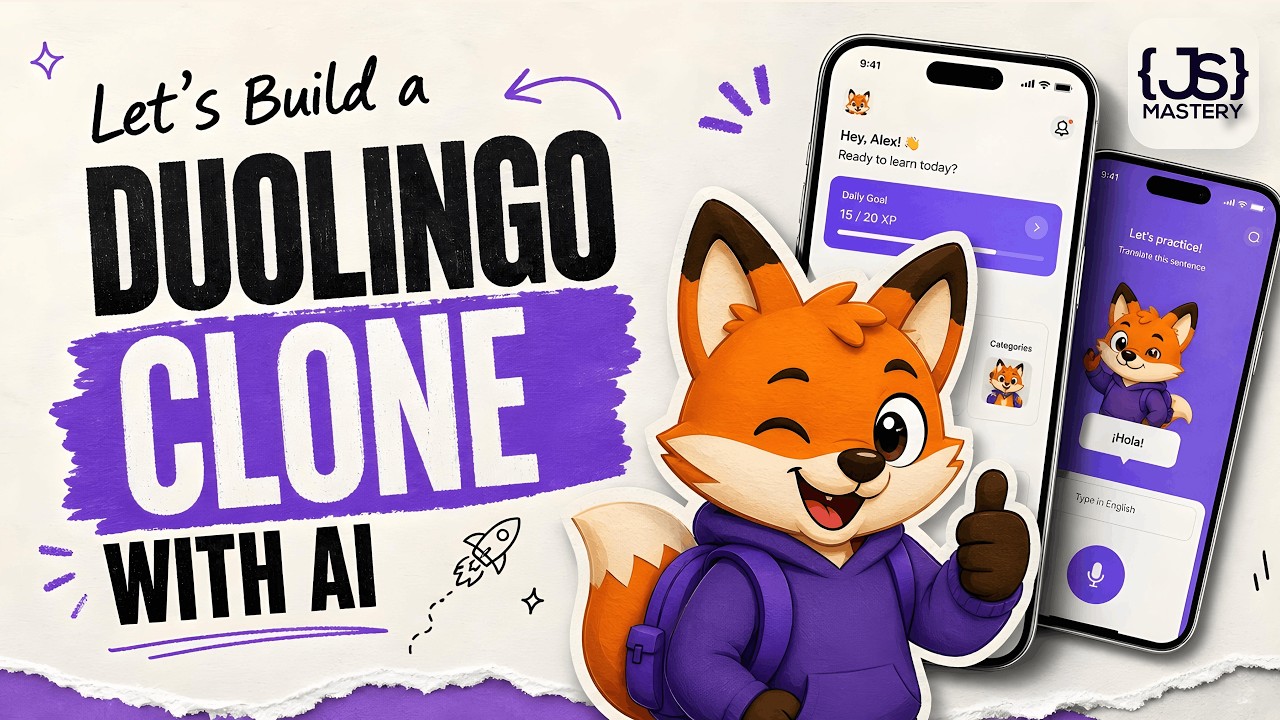
How to Actually Build Mobile Apps with AI in 2026 | A Complete Beginner's Tutorial
BeginnerIn this video, you will learn how to build a full Duolingo clone in React Native using a workflow called Practical Vibe Coding. AI has turned months of work into a single weekend; allowing you to ship a real apps without writing a single line of code. The app isn't the point; the workflow is. Let’s go. Stream: https://jsm.dev/lingua-stream Vision Agents: https://jsm.dev/lingua-vision Clerk: https://jsm.dev/lingua-clerk PostHog: https://jsm.dev/lingua-posthog CodeRabbit: https://jsm.dev/lingua-coderabbit 💎Agentic Engineering Course: https://jsm.dev/ai 📘 Practical Vibe Coding Guide: https://jsm.dev/lingua-ebook 🎁 Video Kit (Code, Assets, Prompts): https://jsm.dev/lingua-kit 🤖 Android Studio/Windows Guide: https://jsm.dev/lingua-android ➤ Links not working? Some regions may need a VPN. https://discord.com/invite/n6EdbFJ https://twitter.com/jsmasterypro https://instagram.com/javascriptmastery https://linkedin.com/company/javascriptmastery Business Inquiries: contact@jsmastery.pro Timestamps: 00:00:00 — Introduction 00:03:07 — Crash Course - AGENTS.md 00:15:13 — Crash Course - When the AI’s Knowledge Ends 00:23:47 — Setup 00:28:37 — AGENTS.md Setup 00:38:01 — Nativewind Setup 00:47:13 — Design Theme 00:58:26 — Onboarding Screen 01:08:58 — Auth Screen 01:15:45 — Clerk 01:27:04 — Content 01:33:27 — Language Screen 01:39:01 — State Management 01:45:16 — Bottom Tab Navigation 01:51:30 — Home UI 02:00:23 — PostHog 02:14:57 — Lesson UI 02:19:55 — Audio Lesson UI 02:25:25 — Stream 02:28:17 — XCode & Android Studio Setup 02:39:35 — Stream Integration 02:47:51 — Vision Agent 02:53:45 — AI Teacher 03:04:56 — AI Teacher Improvements 03:15:29 — Live Captions 03:28:58 — More PostHog 03:38:05 — End


How to Build & Sell Web Apps With AI Without Coding (FULL COURSE)
BeginnerWant an AI Makeover for YOUR Business? 👉🏻 https://bit.ly/aimakeover Follow me on Instagram to see behind the scenes: 🤳🏼 https://instagram.com/liamottley 🛠 MY TECH STACK Hostinger (agent & web hosting): https://hostinger.com/liamvps Hyperagent (AIOS workspace): https://www.hyperagent.com/liam Ospry (AI lead gen): https://www.ospry.ai?fpr=liam41 Glaido (voice transcription): https://get.glaido.com/liam-ottley Firecrawl (web scraping): https://firecrawl.link/liam-ottley Supadata (video scraping): https://supadata.ai/?ref=liam Apify (all other scraping): https://apify.com?fpr=8txghh ElevenLabs (voice agents & cloning): https://try.elevenlabs.io/liam Claude Code (coding): https://claude.com/claude-code Supabase (database): https://supabase.com Some links above are affiliate links. Using them supports the channel at no extra cost. 📚 Get the Figma kit, app prompts, and UI Designer tool & all my AI resources on Skool: https://bit.ly/46Fo98a 📈 Become a Wildly Profitable AI Entrepreneur: https://bit.ly/47iFLGW 🤝 Ready to transform your business with AI? Let's talk: https://bit.ly/4fnpOS0 📋 Get our FREE 14-day playbook for finding high-impact AI opportunities in any business: https://bit.ly/14-day-playbook- In this full course, you’ll master the new skill of Software Composing—building full-stack, revenue-generating web apps using nothing but your ideas and the right prompts. You’ll go from understanding databases and APIs to deploying a real SaaS product with authentication, live data and a real database. No coding experience? No problem. This course was built to help you gain the confidence and competence to turn ideas into income using natural language prompts or 'vibe coding' and the world’s most powerful AI tools like Bolt.new the sponsor of this video. Get started building no-code apps with Bolt now: https://bolt.new/ Timestamps: 0:00 - What We're Covering 2:47 - Chapter 1: Foundations 4:31 - What is Software Composing? 10:46 - What is a Web App? 13:35 - Front End VS Back End 18:48 - Databases: Your Software’s Memory 23:43 - APIs 29:29 - Authentication & Authorization 34:33 - Chapter 2: Building 37:00 - The Software Composing Landscape 41:03 - Build 1: Front End: UI Design & Initial Prompting 56:30 - Build 2: Backend: Databases & API 1:12:21 - Build 3: User Authentication & Authorization 1:30:59 - Deploying your App 1:34:00 - Debugging: Fixing What Breaks 1:37:34 - Chapter 3: Monetizing


Learn Full Excel course from Basic to Advanced with A.I. | Excel with A.I Masterclass
Beginner📘 10 Hours Excel Basic to Advance Course With AI | Full Video Tutorial #LM763 In this Excel tutorial, you will learn Microsoft Excel from basic to advanced level in a complete 10-hour step-by-step video. This course is designed for beginners, students, job seekers, business professionals, and anyone who wants to master Excel with the help of AI-powered productivity tools. From essential formulas to advanced Pivot Tables, dashboards, and AI features, this video provides everything you need to become confident and job-ready in Excel. 🔥 What You Will Learn ✔ Excel Interface & Basics ✔ Formulas and Functions ✔ Data Cleaning, Sorting & Filtering ✔ Conditional Formatting ✔ Data Validation & Data Tools ✔ Pivot Tables, Pivot Charts & Dashboards ✔ Advanced Formulas (VLOOKUP, INDEX, MATCH, Logical & Statistical) ✔ Excel Automation & AI Features Detailed Timestamps / Chapters 00:10 – Introduction 09:25 – Excel Introduction 47:01 – Basic Formulas in Excel 1:06:08 – Conditional Formatting 1:23:30 – Sorting Data in Excel 1:40:13 – Filter in Excel 2:04:41 – Data Validation 2:19:51 – Data Tools 2:30:32 – Sheet & File Protection 2:42:13 – Find, Replace & Paste Special 2:57:32 – Printing Essentials 3:08:45 – Excel Pivot Table Basics 3:25:09 – Pivot Charts 3:32:59 – Slicers & Slicer Settings 3:49:40 – Timeline in Pivot Table 3:56:31 – Grouping & Custom Grouping 4:04:25 – Pivot Table Options & Settings 4:23:22 – Show Values As 4:37:43 – Calculated Fields 4:47:37 – Filters & Filter Reports Page 4:54:47 – Dynamic Pivot Tables 5:04:40 – Pivot Table on Multiple Sheets 5:15:32 – GETPIVOTDATA Formula 5:24:08 – Auto-Refresh Pivot Table 5:27:06 – Creating a Dashboard Using Pivot Tables 6:37:43 – Logical Functions 6:58:59 – VLOOKUP, MATCH & INDEX 7:45:33 – Statistical Formulas 8:13:47 – Date Formulas 8:32:40 – Excel with AI #ExcelTutorial#ExcelCourse#ExcelTraining #ExcelBasicToAdvanced#LearnExcel#excelforbeginners Meet me on Linkedin : https://www.linkedin.com/in/satish-dhawale/ My Data Analysis related content Channel : https://www.youtube.com/@Satish_Dhawale Download All Practice Files : https://drive.google.com/uc?export=download&id=1ceNwz0vTx79mM1O8iIWGkySJuUGtIzKF Get Free Notification for Upcoming Videos = https://forms.gle/9G2xL2c5XrA14HvbA ------------------------------------------------------------------------------------------------------------------------------ Learn Satish Sir courses with Certificate Course Website :https://bit.ly/skill_course Course Features : ✅ सभी Videos सरल हिंदी भाषा में ✅ Basic to Advance Courses ✅ Practice Files (Yes) ✅ PDF Shortcuts ✅ Course Completion Certificate ✅ Instant Access ✅ Watch on Desktop : https://skillcourse.in/ ------------------------------------------------------------------------------------------------------------------------------ Check our latest blogs: https://learnmoreindia.in/ ------------------------------------------------------------------------------------------------------------------------------ Social media Pages: Facebook Page Link: https://bit.ly/3CvGlBT Instagram Page Link: https://bit.ly/3f9R37u Telegram channel: https://telegram.me/learnmoreindia ------------------------------------------------------------------------------------------------------------------------------ For Short tips : https://www.youtube.com/@Skill-Course My Other Channels: Excel Tutorial:✅ https://www.youtube.com/@Excel_Tutorial Complete Technology:✅ https://www.youtube.com/@CompleteTechnology Satish Tech (Marathi):✅ https://www.youtube.com/@Satish_Tech Tally Tutorial:✅ https://www.youtube.com/@TallyTutorial Learn More:✅ https://www.youtube.com/@Learn_More_Pro ------------------------------------------------------------------------------------------------------------------------------ My YouTube Gears : Best Mic for Recording (Condensor Mic): https://amzn.to/2UUMDnH Best Mic for Recording (Dynamic Mic ): https://amzn.to/3pQgyvD My DSLR Camera Canon 200D: https://amzn.to/39ciw3E My Laptop (Video Editing): https://amzn.to/2UXQj8h Laptop (Office Use/ Home use / Budget Laptop) : https://amzn.to/3l0pniw Antivirus: https://amzn.to/3l3TIgi Screen Recording Software: https://bit.ly/2J39n2j Video Editing Software: https://bit.ly/3nOPlri Green screen with Stand: https://amzn.to/2KAl1Cu

Complete Agentic AI Course In 10 Hours- Langchain, Langgraph, RAG,Vectorless RAG, Guardrails,Evals
IntermediateThis is a complete course on learning Generative ai and agentic with Langchain and Langgraph. We have included all the topics from RAG, vectorless rag, Deep agents, Guardrails, LLM Evaluation and LLM Gateways Techniques Github Links Langchain : https://github.com/krishnaik06/Langchain-V1-Crash-Course Langgraph: https://github.com/krishnaik06/Agentic-LanggraphCrash-course RAG: https://github.com/krishnaik06/RAG-Tutorials Vectorless RAG: https://github.com/krishnaik06/RAG-Tutorials/blob/main/PageIndex_Vectorless_RAG_CrashCourse%20(1).ipynb Deep Agents: https://drive.google.com/file/d/1SVjvgqvKfF-FPAIqpEZdKMQLhe13NLFD/view Guardrails : https://github.com/krishnaik06/Langchain-V1-Crash-Course/blob/main/updatedlangchain/langchain_guardrails_crash_course.ipynb LLM Evals : https://github.com/krishnaik06/RAG-Tutorials/blob/main/1-rag_evaluation.ipynb LLM Gateways: https://github.com/krishnaik06/Langchain-V1-Crash-Course/blob/main/llm_gateway_tutorial.ipynb Timestamp 00:00:00 Introduction 00:02:31 Langchain Course 02:35:12 Langraph Course 05:02:29 RAG Course 07:10:43 Vectorless RAG 08:02:11 Deep Agents 08:45:43 Guardrails 09:22:55 LLM Evaluation 10:30:25 LLM Gateways ------------------------------------------------------------------- Learn from us visit https://krishnaik.in/liveclasses


Full Walkthrough: Workflow for AI Coding — Matt Pocock
IntermediateA hands-on workshop covering the full lifecycle of AI-assisted development, from turning ambiguous requirements into agent-ready plans to running autonomous coding agents that ship production features. You'll learn to stress-test vague briefs into structured PRDs, slice work into thin "tracer bullet" vertical slices, and run an AI agent with TDD. You'll watch it select tasks, write tests, implement code, and commit. You'll then refine your prompts based on where it struggles, graduate to fully autonomous (AFK) runs, and learn to design codebases that maximize agent effectiveness. You'll walk away knowing how to: - Turn ambiguous requirements into agent-ready issues - Slice work into vertical tracer bullets an agent can grab independently - Run AI agents human-in-the-loop and autonomously with TDD - Design codebase architectures that AI agents love to work in For: Engineers ready to move beyond chat-based AI assistance and build a real workflow for shipping features with autonomous coding agents. Speaker info: - https://x.com/mattpocockuk - https://www.linkedin.com/in/mapocock/ - https://youtube.com/@mattpocockuk Timestamps: 00:00:00 - Introduction 00:00:14 - The Thesis of AI Engineering 00:04:20 - Phase 1: Research & Prototyping 00:12:45 - Phase 2: The Grill Session 00:22:10 - Phase 3: Writing the PRD 00:35:50 - Phase 4: Slicing Work into Issues 00:48:15 - Phase 5: Implementation with AI Agents 01:05:30 - Phase 6: Human-in-the-Loop Review 01:18:45 - Phase 7: Deployment & Monitoring 01:28:10 - Designing Codebases for AI Effectiveness 01:34:06 - Final Takeaways & Summary --- Watch along with the corrected transcript, summary, timestamps and resources on this talk's official AIE page: https://ai.engineer/talks/-QFHIoCo-Ko-ai-coding-workflow Join our upcoming AI Engineer conferences (see https://ai.engineer landing page): - AIE New York, October 12–14 — the first AI Engineer Finance mainstage summit - AIEi Shanghai, November 5–6 — the first for meeting top Chinese labs and engineers - AIE CODE in SF, November 10–12 — the top AI Coding conference returns - AIEi Sydney, December 7–8 — the first AIEi run alongside NeurIPS 2026 in Sydney ---
![Claude Code for Beginners Tutorial [Full Course]](https://i.ytimg.com/vi/gh2_PhgZGsM/maxresdefault.jpg)

Claude Code for Beginners Tutorial [Full Course]
BeginnerLearn all about Claude Code. This is the ultimate guide to turning Anthropic’s Claude into a seamless part of your development workflow. Whether you're scaffolding a brand-new project or navigating a complex, multi-file codebase, this is how you code faster without sacrificing quality. 🔗 IMPORTANT LINKS 🔬 Practice with Hands-On Labs: https://kode.wiki/claude-code 🎓 Get the Full Course here: https://kode.wiki/claude-code-course ❤️ Support for this channel comes from our friends at Scrimba – the coding platform that's reinvented interactive learning: https://scrimba.com/freecodecamp ⭐️ Contents ⭐️ 0:00:00 Introduction 0:00:30 Prerequisites and Initial Setup 0:09:25 Start your first session 0:23:58 Understanding Codebases with Claude 0:32:21 Installing Claude on Ubuntu Virtual Machines 0:49:34 Building a project from scratch 0:49:34 Getting project ready for public release 0:56:49 Creating Unit Tests for our Project 1:03:20 Autonomous Task Completion 1:17:11 Environment and Configuration Management 1:30:17 Managing Long Sessions Effectively 2:07:52 Writing Effective Development Prompts 2:23:39 Multi-file Project Navigation 2:32:10 Working with APIs and External Services 2:46:16 Initial Project Analysis 2:56:24 Design Pattern Implementation Review 3:05:50 SOLID Principles Evaluation 3:24:04 Error Handling & Resilience Audit 3:36:04 Exception Flow Analysis 3:52:12 Resilience & Fault Tolerance 3:53:09 Code Quality Metrics & Standards 4:02:17 Code Duplication Detection 4:12:14 Naming Conventions & Readability 4:19:23 Test Coverage & Quality Analysis 🎉 Thanks to our Champion and Sponsor supporters: 👾 @omerhattapoglu1158 👾 @goddardtan 👾 @akihayashi6629 👾 @kikilogsin 👾 @anthonycampbell2148 👾 @tobymiller7790 👾 @rajibdassharma497 👾 @CloudVirtualizationEnthusiast 👾 @adilsoncarlosvianacarlos 👾 @martinmacchia1564 👾 @ulisesmoralez4160 👾 @_Oscar_ 👾 @jedi-or-sith2728 👾 @justinhual1290 -- Learn to code for free and get a developer job: https://www.freecodecamp.org Read hundreds of articles on programming: https://freecodecamp.org/news


Hermes Agent is the greatest AI tool ever made. Here's how to set it up
IntermediateHermes Agent is the best AI tool out there. Here is your COMPLETE tutorial. FULL Hermes Agent bootcamp in the Vibe Coding Academy coming up: https://www.skool.com/vibe-coding-academy 2nd Youtube Channel: https://youtube.com/@AlexFinnLabsOfficial Sign up for my free newsletter: https://www.alexfinn.ai/subscribe Follow my X: https://x.com/AlexFinn Henry Intelligent Machines (my new startup): https://meethenry.ai My $300k/yr AI app: https://www.creatorbuddy.io/ Prompts: I want you to schedule a task for yourself to do every single night at 2am. It should be a micro app, UI, or system that helps us get closer to my personal goals and ambitions. It should save us time, make us more productive, or just be generally useful. Make sure this is scheduled for every single night at 2am. hermes-agent.nousresearch.com Timestamps: 0:00 Intro 1:50 What Hermes Agent is 3:13 Hermes vs OpenClaw 5:17 Hermes vs Claude Code 7:57 Hermes installation 9:28 Choosing a model 13:44 First things to do 18:02 Hermes dashboard 21:00 Hermes Kanban board 23:15 Use case 1 25:40 Use case 2 27:47 Use case 3 29:40 Memory and skills 34:30 Mission control 37:38 Troubleshooting 38:42 Security

FULL Claude Tutorial For Beginners in 2026! (FULL COURSE)
Beginner🚀 Join Ai Foundations - https://aifoundations.io/join-carter This is the only Claude tutorial you’ll ever need. With this guide you can go from beginner to pro using Claude. I cover the basics like signing up, settings, memory, prompting and we work our way up to the intermediate features like Claude projects, artifacts, inline visualizations, data analytics and more. Then we finally dive into Claude desktop, where I teach you how to use Claude Cowork with computer use, scheduled tasks, and connectors for Notion, Gmail and Google Calendar. I even show you how to build Claude skills from scratch. After you have a beginner's understanding of Claude we dive into Claude Code. I show you how to deploy a real website in Netlify and even control Claude through a remote environment on Anthropics servers. We cover github, environment variables, pretty much everything you need, explained in beginner terms. I even cover exporting your ChatGPT memories and bringing them over to Claude. If you've been hearing about Claude AI, Claude Cowork, or Claude Code and wondering how it all fits together: this is the video you’ve been searching for. I walk through everything step-by-step leaving no stone unturned. Utilize the chapters and resources below to get the most out of this video. If it’s your first time watching, I recommend watching all the way through at least once, then coming back to spend extra time on specific chapters! Resources Mentioned: Join Ai Foundations - https://aifoundations.io/join-carter DBS Framework Skill - https://aifoundations.io/resources/the-dbs-framework-skill Claude Code Mastery - https://aifoundations.io/products/claude-code-mastery Sign up for Claude - https://claude.ai Chapters: 0:00 - Claude Tutorial Intro 0:25 - How to Use This Guide 0:40 - Claude Pricing Comparison 1:22 - Sign Up for Claude 1:49 - Claude Onboarding 3:10 - Claude Chat Layout 3:50 - General Settings 4:53 - Notifications 6:00 - Claude Appearance 6:35 - Claude Voices 6:51 - Privacy and Billing 8:02 - Claude Memory 8:26 - Exporting Memories from ChatGPT 9:21 - Tool Settings 10:14 - Claude Artifact Settings 11:23 - Code Permissions 12:10 - Connector Settings 13:00 - Language Settings 13:15 - Claude Status and Support 13:50 - Gifting Claude 14:23 - Keyboard Shortcuts 14:40 - Claude Models 16:15 - Attachments and Connections 17:10 - Writing Styles in Claude 17:53 - Talking to Claude Voice 19:00 - Organizing Chats 19:40 - Incognito Chats 20:20 - GCAO Prompt Template 21:50 - Prompting Claude 24:50 - Ai Foundations Offers 25:38 - Claude Chat Search 26:34 - Claude Projects Guide 27:18 - Project Instructions 29:40 - Projects Guide Continued 30:56 - Claude Artifacts Library 32:37 - Creating Claude Artifacts 36:40 - Sharing Artifacts 37:15 - Mini App Artifacts 38:35 - Inline Visualizations 39:00 - Visualizing Data Analytics 41:15 - Claude Desktop 42:45 - Claude Cowork Setup 44:00 - Claude Quick Chat 45:00 - Cowork Settings Continued 47:00 - Organizing Files in Cowork 48:20 - Claude Computer Use 49:30 - Cowork Scheduled Tasks 51:22 - Cowork Projects 52:40 - Cowork Prospecting Project 55:00 - Claude in Chrome Extension 56:10 - Cowork Project Results 57:05 - Claude Dispatch Setup 57:50 - Cowork Connectors 58:20 - Claude Notion MCP Connector 59:30 - Using Connectors 1:00:18 - Claude Gmail Connector 1:02:40 - Claude Skills 1:04:18 - DBS Framework Skill 1:05:30 - Uploading Skills 1:06:00 - Creating a Basic Skill 1:07:36 - Testing the Recipe Skill 1:09:25 - Creating an Advanced Skill 1:10:20 - Google Calendar Connector 1:12:24 - Testing the Calendar Skill 1:13:10 - Claude Code Prerequisite 1:14:20 - Claude Code Mastery 1:15:23 - Two Ways to Use Claude Code 1:15:48 - Claude Code Environments 1:17:45 - Claude Code Models 1:18:10 - Claude Code Effort 1:18:34 - Claude Code Permissions 1:18:50 - Claude Code Enhancements 1:20:20 - Folder Setup 1:21:30 - Creating Claude MD 1:22:12 - Opening Files Quickly 1:22:31 - Building a Personal Website 1:25:15 - Planning with Claude Code 1:28:05 - Plan Mode in Claude Code 1:28:45 - Editing My Site 1:29:19 - The Complete Website 1:30:00 - Deploying with Netlify Connector 1:31:12 - Setting a Domain Name 1:31:45 - Adding Environment Variables 1:34:00 - Testing Email Connection 1:34:30 - Creating Remote Skills 1:36:18 - Github Repo Setup 1:37:00 - Initial Commit in Github 1:38:00 - Claude Code Cloud Environments 1:39:00 - Claude Code on my Phone 1:39:55 - Netlify + Github Deployment Setup 1:41:00 - Updating My Website 1:42:00 - Website Complete 1:42:20 - Claude Code Scheduled Tasks 1:44:24 - Scheduled Tasks with Skills 1:47:30 - Updating My Website from Anywhere 1:49:50 - Claude Code Terminal 1:50:30 - Claude Code Commands 1:51:10 - Claude Code Terminal Test 1:51:58 - Final Thoughts #claude #claudecowork #claudecode


Deep Dive into LLMs like ChatGPT
IntermediateThis is a general audience deep dive into the Large Language Model (LLM) AI technology that powers ChatGPT and related products. It is covers the full training stack of how the models are developed, along with mental models of how to think about their "psychology", and how to get the best use them in practical applications. I have one "Intro to LLMs" video already from ~year ago, but that is just a re-recording of a random talk, so I wanted to loop around and do a lot more comprehensive version. Instructor Andrej was a founding member at OpenAI (2015) and then Sr. Director of AI at Tesla (2017-2022), and is now a founder at Eureka Labs, which is building an AI-native school. His goal in this video is to raise knowledge and understanding of the state of the art in AI, and empower people to effectively use the latest and greatest in their work. Find more at https://karpathy.ai/ and https://x.com/karpathy Chapters 00:00:00 introduction 00:01:00 pretraining data (internet) 00:07:47 tokenization 00:14:27 neural network I/O 00:20:11 neural network internals 00:26:01 inference 00:31:09 GPT-2: training and inference 00:42:52 Llama 3.1 base model inference 00:59:23 pretraining to post-training 01:01:06 post-training data (conversations) 01:20:32 hallucinations, tool use, knowledge/working memory 01:41:46 knowledge of self 01:46:56 models need tokens to think 02:01:11 tokenization revisited: models struggle with spelling 02:04:53 jagged intelligence 02:07:28 supervised finetuning to reinforcement learning 02:14:42 reinforcement learning 02:27:47 DeepSeek-R1 02:42:07 AlphaGo 02:48:26 reinforcement learning from human feedback (RLHF) 03:09:39 preview of things to come 03:15:15 keeping track of LLMs 03:18:34 where to find LLMs 03:21:46 grand summary Links - ChatGPT https://chatgpt.com/ - FineWeb (pretraining dataset): https://huggingface.co/spaces/HuggingFaceFW/blogpost-fineweb-v1 - Tiktokenizer: https://tiktokenizer.vercel.app/ - Transformer Neural Net 3D visualizer: https://bbycroft.net/llm - llm.c Let's Reproduce GPT-2 https://github.com/karpathy/llm.c/discussions/677 - Llama 3 paper from Meta: https://arxiv.org/abs/2407.21783 - Hyperbolic, for inference of base model: https://app.hyperbolic.xyz/ - InstructGPT paper on SFT: https://arxiv.org/abs/2203.02155 - HuggingFace inference playground: https://huggingface.co/spaces/huggingface/inference-playground - DeepSeek-R1 paper: https://arxiv.org/abs/2501.12948 - TogetherAI Playground for open model inference: https://api.together.xyz/playground - AlphaGo paper (PDF): https://discovery.ucl.ac.uk/id/eprint/10045895/1/agz_unformatted_nature.pdf - AlphaGo Move 37 video: https://www.youtube.com/watch?v=HT-UZkiOLv8 - LM Arena for model rankings: https://lmarena.ai/ - AI News Newsletter: https://buttondown.com/ainews - LMStudio for local inference https://lmstudio.ai/ - The visualization UI I was using in the video: https://excalidraw.com/ - The specific file of Excalidraw we built up: https://drive.google.com/file/d/1EZh5hNDzxMMy05uLhVryk061QYQGTxiN/view?usp=sharing - Discord channel for Eureka Labs and this video: https://discord.gg/3zy8kqD9Cp Educational Use Licensing This video is freely available for educational and internal training purposes. Educators, students, schools, universities, nonprofit institutions, businesses, and individual learners may use this content freely for lessons, courses, internal training, and learning activities, provided they do not engage in commercial resale, redistribution, external commercial use, or modify content to misrepresent its intent.